
330 lines
11 KiB
Rust
330 lines
11 KiB
Rust
//! [![github]](https://github.com/dtolnay/itoa) [![crates-io]](https://crates.io/crates/itoa) [![docs-rs]](https://docs.rs/itoa)
|
|
//!
|
|
//! [github]: https://img.shields.io/badge/github-8da0cb?style=for-the-badge&labelColor=555555&logo=github
|
|
//! [crates-io]: https://img.shields.io/badge/crates.io-fc8d62?style=for-the-badge&labelColor=555555&logo=rust
|
|
//! [docs-rs]: https://img.shields.io/badge/docs.rs-66c2a5?style=for-the-badge&labelColor=555555&logo=docs.rs
|
|
//!
|
|
//! <br>
|
|
//!
|
|
//! This crate provides a fast conversion of integer primitives to decimal
|
|
//! strings. The implementation comes straight from [libcore] but avoids the
|
|
//! performance penalty of going through [`core::fmt::Formatter`].
|
|
//!
|
|
//! See also [`ryu`] for printing floating point primitives.
|
|
//!
|
|
//! [libcore]: https://github.com/rust-lang/rust/blob/b8214dc6c6fc20d0a660fb5700dca9ebf51ebe89/src/libcore/fmt/num.rs#L201-L254
|
|
//! [`ryu`]: https://github.com/dtolnay/ryu
|
|
//!
|
|
//! # Example
|
|
//!
|
|
//! ```
|
|
//! fn main() {
|
|
//! let mut buffer = itoa::Buffer::new();
|
|
//! let printed = buffer.format(128u64);
|
|
//! assert_eq!(printed, "128");
|
|
//! }
|
|
//! ```
|
|
//!
|
|
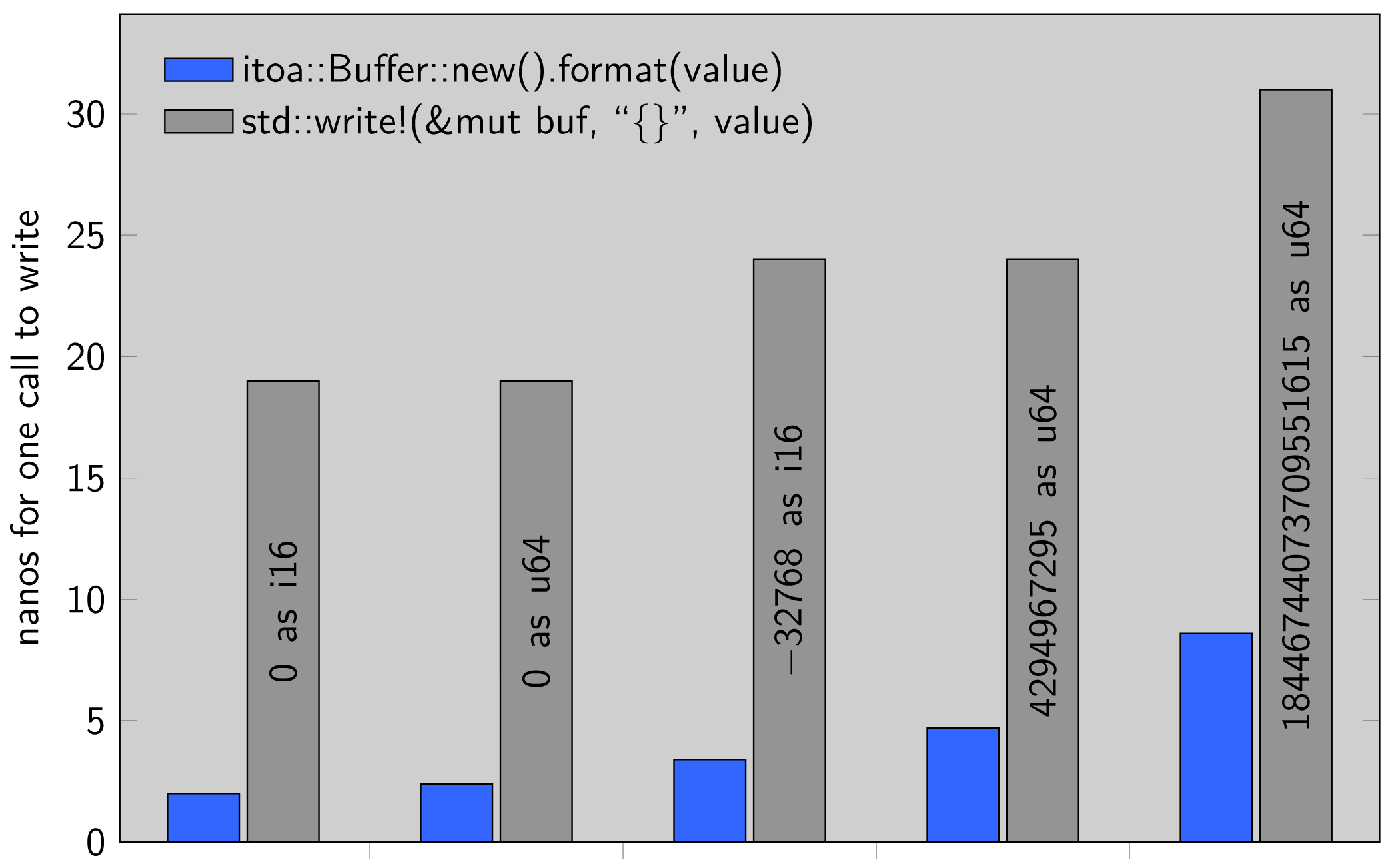
//! # Performance (lower is better)
|
|
//!
|
|
//! 
|
|
|
|
#![doc(html_root_url = "https://docs.rs/itoa/1.0.15")]
|
|
#![no_std]
|
|
#![allow(
|
|
clippy::cast_lossless,
|
|
clippy::cast_possible_truncation,
|
|
clippy::cast_possible_wrap,
|
|
clippy::cast_sign_loss,
|
|
clippy::expl_impl_clone_on_copy,
|
|
clippy::must_use_candidate,
|
|
clippy::needless_doctest_main,
|
|
clippy::unreadable_literal
|
|
)]
|
|
|
|
mod udiv128;
|
|
|
|
use core::hint;
|
|
use core::mem::MaybeUninit;
|
|
use core::{ptr, slice, str};
|
|
#[cfg(feature = "no-panic")]
|
|
use no_panic::no_panic;
|
|
|
|
/// A correctly sized stack allocation for the formatted integer to be written
|
|
/// into.
|
|
///
|
|
/// # Example
|
|
///
|
|
/// ```
|
|
/// let mut buffer = itoa::Buffer::new();
|
|
/// let printed = buffer.format(1234);
|
|
/// assert_eq!(printed, "1234");
|
|
/// ```
|
|
pub struct Buffer {
|
|
bytes: [MaybeUninit<u8>; i128::MAX_STR_LEN],
|
|
}
|
|
|
|
impl Default for Buffer {
|
|
#[inline]
|
|
fn default() -> Buffer {
|
|
Buffer::new()
|
|
}
|
|
}
|
|
|
|
impl Copy for Buffer {}
|
|
|
|
impl Clone for Buffer {
|
|
#[inline]
|
|
#[allow(clippy::non_canonical_clone_impl)] // false positive https://github.com/rust-lang/rust-clippy/issues/11072
|
|
fn clone(&self) -> Self {
|
|
Buffer::new()
|
|
}
|
|
}
|
|
|
|
impl Buffer {
|
|
/// This is a cheap operation; you don't need to worry about reusing buffers
|
|
/// for efficiency.
|
|
#[inline]
|
|
#[cfg_attr(feature = "no-panic", no_panic)]
|
|
pub fn new() -> Buffer {
|
|
let bytes = [MaybeUninit::<u8>::uninit(); i128::MAX_STR_LEN];
|
|
Buffer { bytes }
|
|
}
|
|
|
|
/// Print an integer into this buffer and return a reference to its string
|
|
/// representation within the buffer.
|
|
#[cfg_attr(feature = "no-panic", no_panic)]
|
|
pub fn format<I: Integer>(&mut self, i: I) -> &str {
|
|
let string = i.write(unsafe {
|
|
&mut *(&mut self.bytes as *mut [MaybeUninit<u8>; i128::MAX_STR_LEN]
|
|
as *mut <I as private::Sealed>::Buffer)
|
|
});
|
|
if string.len() > I::MAX_STR_LEN {
|
|
unsafe { hint::unreachable_unchecked() };
|
|
}
|
|
string
|
|
}
|
|
}
|
|
|
|
/// An integer that can be written into an [`itoa::Buffer`][Buffer].
|
|
///
|
|
/// This trait is sealed and cannot be implemented for types outside of itoa.
|
|
pub trait Integer: private::Sealed {
|
|
/// The maximum length of string that formatting an integer of this type can
|
|
/// produce on the current target platform.
|
|
const MAX_STR_LEN: usize;
|
|
}
|
|
|
|
// Seal to prevent downstream implementations of the Integer trait.
|
|
mod private {
|
|
#[doc(hidden)]
|
|
pub trait Sealed: Copy {
|
|
#[doc(hidden)]
|
|
type Buffer: 'static;
|
|
fn write(self, buf: &mut Self::Buffer) -> &str;
|
|
}
|
|
}
|
|
|
|
const DEC_DIGITS_LUT: [u8; 200] = *b"\
|
|
0001020304050607080910111213141516171819\
|
|
2021222324252627282930313233343536373839\
|
|
4041424344454647484950515253545556575859\
|
|
6061626364656667686970717273747576777879\
|
|
8081828384858687888990919293949596979899";
|
|
|
|
// Adaptation of the original implementation at
|
|
// https://github.com/rust-lang/rust/blob/b8214dc6c6fc20d0a660fb5700dca9ebf51ebe89/src/libcore/fmt/num.rs#L188-L266
|
|
macro_rules! impl_Integer {
|
|
($t:ty[len = $max_len:expr] as $large_unsigned:ty) => {
|
|
impl Integer for $t {
|
|
const MAX_STR_LEN: usize = $max_len;
|
|
}
|
|
|
|
impl private::Sealed for $t {
|
|
type Buffer = [MaybeUninit<u8>; $max_len];
|
|
|
|
#[allow(unused_comparisons)]
|
|
#[inline]
|
|
#[cfg_attr(feature = "no-panic", no_panic)]
|
|
fn write(self, buf: &mut [MaybeUninit<u8>; $max_len]) -> &str {
|
|
let is_nonnegative = self >= 0;
|
|
let mut n = if is_nonnegative {
|
|
self as $large_unsigned
|
|
} else {
|
|
// Convert negative number to positive by summing 1 to its two's complement.
|
|
(!(self as $large_unsigned)).wrapping_add(1)
|
|
};
|
|
let mut curr = buf.len();
|
|
let buf_ptr = buf.as_mut_ptr() as *mut u8;
|
|
let lut_ptr = DEC_DIGITS_LUT.as_ptr();
|
|
|
|
// Render 4 digits at a time.
|
|
while n >= 10000 {
|
|
let rem = n % 10000;
|
|
n /= 10000;
|
|
|
|
let d1 = ((rem / 100) << 1) as usize;
|
|
let d2 = ((rem % 100) << 1) as usize;
|
|
curr -= 4;
|
|
unsafe {
|
|
ptr::copy_nonoverlapping(lut_ptr.add(d1), buf_ptr.add(curr), 2);
|
|
ptr::copy_nonoverlapping(lut_ptr.add(d2), buf_ptr.add(curr + 2), 2);
|
|
}
|
|
}
|
|
|
|
// Render 2 more digits, if >2 digits.
|
|
if n >= 100 {
|
|
let d1 = ((n % 100) << 1) as usize;
|
|
n /= 100;
|
|
curr -= 2;
|
|
unsafe {
|
|
ptr::copy_nonoverlapping(lut_ptr.add(d1), buf_ptr.add(curr), 2);
|
|
}
|
|
}
|
|
|
|
// Render last 1 or 2 digits.
|
|
if n < 10 {
|
|
curr -= 1;
|
|
unsafe {
|
|
*buf_ptr.add(curr) = (n as u8) + b'0';
|
|
}
|
|
} else {
|
|
let d1 = (n << 1) as usize;
|
|
curr -= 2;
|
|
unsafe {
|
|
ptr::copy_nonoverlapping(lut_ptr.add(d1), buf_ptr.add(curr), 2);
|
|
}
|
|
}
|
|
|
|
if !is_nonnegative {
|
|
curr -= 1;
|
|
unsafe {
|
|
*buf_ptr.add(curr) = b'-';
|
|
}
|
|
}
|
|
|
|
let len = buf.len() - curr;
|
|
let bytes = unsafe { slice::from_raw_parts(buf_ptr.add(curr), len) };
|
|
unsafe { str::from_utf8_unchecked(bytes) }
|
|
}
|
|
}
|
|
};
|
|
}
|
|
|
|
impl_Integer!(i8[len = 4] as u32);
|
|
impl_Integer!(u8[len = 3] as u32);
|
|
impl_Integer!(i16[len = 6] as u32);
|
|
impl_Integer!(u16[len = 5] as u32);
|
|
impl_Integer!(i32[len = 11] as u32);
|
|
impl_Integer!(u32[len = 10] as u32);
|
|
impl_Integer!(i64[len = 20] as u64);
|
|
impl_Integer!(u64[len = 20] as u64);
|
|
|
|
macro_rules! impl_Integer_size {
|
|
($t:ty as $primitive:ident #[cfg(target_pointer_width = $width:literal)]) => {
|
|
#[cfg(target_pointer_width = $width)]
|
|
impl Integer for $t {
|
|
const MAX_STR_LEN: usize = <$primitive as Integer>::MAX_STR_LEN;
|
|
}
|
|
|
|
#[cfg(target_pointer_width = $width)]
|
|
impl private::Sealed for $t {
|
|
type Buffer = <$primitive as private::Sealed>::Buffer;
|
|
|
|
#[inline]
|
|
#[cfg_attr(feature = "no-panic", no_panic)]
|
|
fn write(self, buf: &mut Self::Buffer) -> &str {
|
|
(self as $primitive).write(buf)
|
|
}
|
|
}
|
|
};
|
|
}
|
|
|
|
impl_Integer_size!(isize as i16 #[cfg(target_pointer_width = "16")]);
|
|
impl_Integer_size!(usize as u16 #[cfg(target_pointer_width = "16")]);
|
|
impl_Integer_size!(isize as i32 #[cfg(target_pointer_width = "32")]);
|
|
impl_Integer_size!(usize as u32 #[cfg(target_pointer_width = "32")]);
|
|
impl_Integer_size!(isize as i64 #[cfg(target_pointer_width = "64")]);
|
|
impl_Integer_size!(usize as u64 #[cfg(target_pointer_width = "64")]);
|
|
|
|
macro_rules! impl_Integer128 {
|
|
($t:ty[len = $max_len:expr]) => {
|
|
impl Integer for $t {
|
|
const MAX_STR_LEN: usize = $max_len;
|
|
}
|
|
|
|
impl private::Sealed for $t {
|
|
type Buffer = [MaybeUninit<u8>; $max_len];
|
|
|
|
#[allow(unused_comparisons)]
|
|
#[inline]
|
|
#[cfg_attr(feature = "no-panic", no_panic)]
|
|
fn write(self, buf: &mut [MaybeUninit<u8>; $max_len]) -> &str {
|
|
let is_nonnegative = self >= 0;
|
|
let n = if is_nonnegative {
|
|
self as u128
|
|
} else {
|
|
// Convert negative number to positive by summing 1 to its two's complement.
|
|
(!(self as u128)).wrapping_add(1)
|
|
};
|
|
let mut curr = buf.len();
|
|
let buf_ptr = buf.as_mut_ptr() as *mut u8;
|
|
|
|
// Divide by 10^19 which is the highest power less than 2^64.
|
|
let (n, rem) = udiv128::udivmod_1e19(n);
|
|
let buf1 = unsafe {
|
|
buf_ptr.add(curr - u64::MAX_STR_LEN) as *mut [MaybeUninit<u8>; u64::MAX_STR_LEN]
|
|
};
|
|
curr -= rem.write(unsafe { &mut *buf1 }).len();
|
|
|
|
if n != 0 {
|
|
// Memset the base10 leading zeros of rem.
|
|
let target = buf.len() - 19;
|
|
unsafe {
|
|
ptr::write_bytes(buf_ptr.add(target), b'0', curr - target);
|
|
}
|
|
curr = target;
|
|
|
|
// Divide by 10^19 again.
|
|
let (n, rem) = udiv128::udivmod_1e19(n);
|
|
let buf2 = unsafe {
|
|
buf_ptr.add(curr - u64::MAX_STR_LEN)
|
|
as *mut [MaybeUninit<u8>; u64::MAX_STR_LEN]
|
|
};
|
|
curr -= rem.write(unsafe { &mut *buf2 }).len();
|
|
|
|
if n != 0 {
|
|
// Memset the leading zeros.
|
|
let target = buf.len() - 38;
|
|
unsafe {
|
|
ptr::write_bytes(buf_ptr.add(target), b'0', curr - target);
|
|
}
|
|
curr = target;
|
|
|
|
// There is at most one digit left
|
|
// because u128::MAX / 10^19 / 10^19 is 3.
|
|
curr -= 1;
|
|
unsafe {
|
|
*buf_ptr.add(curr) = (n as u8) + b'0';
|
|
}
|
|
}
|
|
}
|
|
|
|
if !is_nonnegative {
|
|
curr -= 1;
|
|
unsafe {
|
|
*buf_ptr.add(curr) = b'-';
|
|
}
|
|
}
|
|
|
|
let len = buf.len() - curr;
|
|
let bytes = unsafe { slice::from_raw_parts(buf_ptr.add(curr), len) };
|
|
unsafe { str::from_utf8_unchecked(bytes) }
|
|
}
|
|
}
|
|
};
|
|
}
|
|
|
|
impl_Integer128!(i128[len = 40]);
|
|
impl_Integer128!(u128[len = 39]);
|